The Pulsar Engineering
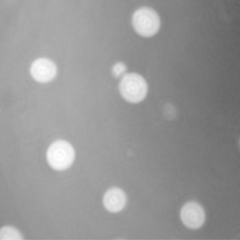

In a previous article I have described an easy method to measure the turbidity of a solution. Lately, Idecided to check if I could be able to track the density of a Saccharomyces cerevisiae ("Baker's yeast") culture in YPD medium. As I didn't have the apparatus to take samples automatically, I decided to make successive dilutions of a mother culture at 10 g/l and to use these as samples.
The results are presented on Figure 1 and compare the output voltage of the turbidity sensor with a simple read-out of light transmission which is the one usually used in lab measurements (known as optical density and usually performed at 600 nm). The good news is that it is relatively easy to measure the transmitted light since our setup is designed to increase the current in the light source (here, a laser) until the voltage on the receptor reaches a fixed value. By measuring the amount of current flowing into the laser, we then have a record of the light transmission in the sample to compare with the turbidity measurement.
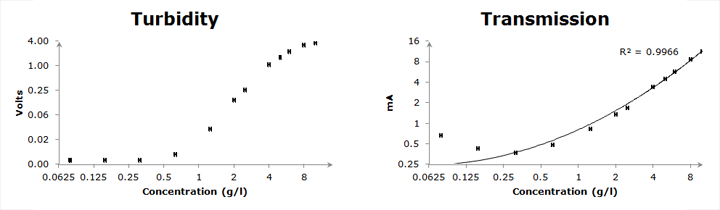
Both techniques works but light transmission seems to be more reliable with a very nice fitting of the data in the 0.3-10 g/l range with an r2 of 0.9966 for a simple 2nd order polynomial. Turbidity has more of a sigmoid shape and could not read dilutions below 0.6 g/l and it is also less sensitive at higher concentrations.
This overall behaviour is interesting as I now know that biomass tracking is better suited by light transmission and not by turbidity. So, was all that turbidity sensor design useless? Well... maybe!