The Pulsar Engineering

Few people know it but LEDs acts as photodiodes when hit by light. As a result, the LED creates a voltage potential and a small current (much less than 1 µA). But an even more interesting fact is that the phenomenon is wavelength-dependent.
In an experiment, two LEDs are placed face-to-face. The first one is connected to a battery with a resistor to limit the current (classical usage) and the second one is connected to a 10 MΩ shunt resistor and a voltmeter to read the eventual activity of the LED. A set of three different LED (red, green, blue) was tested in every possible combination and the results obtained are given on Figure 1.
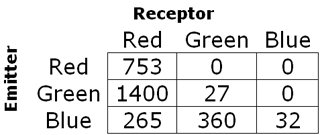
Some pairs have an activity and some doesn't. A deeper analysis will lead to the conclusion that a LED used as photodiode can be triggered only by light of equal or higher photon energy (that is, equal or lower wavelength). Green light can then trigger a red LED but not a blue one. The trick works with any LED, not just red, green and blue ones of course.
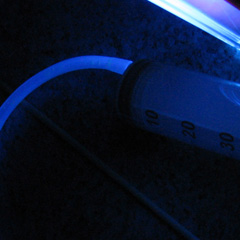
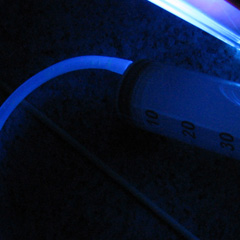
I have successfully used this peculiar behaviour of LEDs to detect fluorescent tracers in fluid paths. The idea is quite simple: a fluorescent tracer will absorb light of wavelength λ1 and emit light of larger wavelength λ2. Using two LEDs that are designed to work at λ1 then do the trick: in the absence of tracer, the light remain unchanged and the second LED (the photoreceptor) triggers but, if the tracer is there, some of the light is absorbed and light of larger wavelength is re-emitted. As the second LED will be insensitive to the larger wavelength, no voltage potential will be read. Obviously, diluted tracer will only absorb part of the light and the overall photoreceptor output will be somewhere between full response and no response.
If you measure both the transmitted light and the overall light (by using a third LED λ3 with λ3 > λ2 or a classical photodiode) you will be able to tell the absorption ratio independently of the eventual liquid turbidity changes. As a consequence, you now have a cheap but reliable fluorescence absorption sensor. Congratulations!
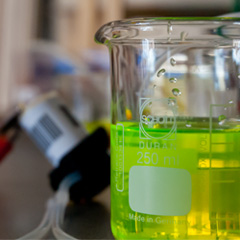
The tracer thing is best illustrated with fluorescein which strongly absorbs blue light and re-emits green-yellowish radiations. Using a blue emitting diode and a cyan receptor yields excellent results. In former tests, I have used two blue LEDs but the read-out voltage was kind of low because equal LED do not generate much output compared to LED that clearly differs (see Figure 1 on its diagonal). The cyan LED was a perfect choice because it just lies between the blue light region and the green-yellow region.
So, why don't you take a couple of minutes to try this out? Fluorescein is available in most pharmacy here in Belgium, just ask a few grams out they'll be happy to help you!